
A fixed dental bridge stays in your mouth, so daily care has to reach the parts a toothbrush can miss. If you want to know how to care for a dental bridge, start with the daily basics. Brush gently twice a day. Clean under the replacement tooth once a day. Call for a checkup when something changes. That routine protects the supporting teeth and gums. Those teeth and gums hold the bridge in place.
Call (619) 295-4545 to schedule a bridge checkup
How to Care for a Dental Bridge Each Day
Brush twice a day, clean under the bridge once daily, and stop if a tool starts to hurt.
A fixed bridge replaces one or more missing teeth and is cemented in place. The artificial tooth that fills the gap is the pontic, and the natural teeth or implants on either side are the abutments. You brush the visible surfaces the way you brush other teeth, but you also need a second step for the underside of the pontic and the edges where the bridge meets the gum.
The American Dental Association explains that toothbrush bristles alone cannot clean tight spaces between teeth. Plaque left there can harden into tartar, which only a dental professional can remove. Around a bridge, that film also collects where the pontic rests near the gum.
A simple daily routine looks like this:
- Brush for two minutes in the morning and again at night with a soft brush and fluoride toothpaste.
- Angle the bristles toward the gumline around the abutments and the edges of the bridge.
- Clean under the pontic once a day with a tool your dentist has said is appropriate.
- Rinse if food is stuck, then finish with the interdental tool rather than skipping it.
- Look for redness, bleeding, or a spot that keeps trapping food, and mention it at your next visit.
Do not use a hard brush, whitening paste as a scrub, or a toothpick forced under the pontic, because those can scratch restoration surfaces or irritate the gum. If a cleaning tool will not pass without pain, stop and ask for a demonstration instead of pushing harder.
Brush the Bridge, the Abutments, and the Gumline
Use a soft brush and fluoride toothpaste, and keep a light angle along the gumline.
Brush the chewing surface of the bridge, the sides you can see, and the natural teeth that support it. Spend a little extra time where the bridge meets the gum. Plaque tends to sit in that seam. A soft-bristled brush is enough. Pressing harder does not clean better, and it can make the gum tender.
Fluoride toothpaste helps the abutment teeth resist decay. The bridge material itself does not get a cavity, but the teeth underneath the crowns can, and decay on an abutment is one reason a bridge later needs repair or replacement. Spit after brushing if that is your usual habit, and avoid a vigorous rinse that washes away all of the fluoride unless your dentist has told you otherwise.
Electric brushes are fine when the head is soft and you let the brush do the work. Hold it on each surface for a few seconds rather than scrubbing across the pontic. If the brush head is frayed, replace it. Worn bristles do a poor job along the gumline.
- Do: brush morning and night, including the inner surfaces facing the tongue.
- Do: clean the gumline with short, gentle strokes.
- Avoid: abrasive “whitening” powders on the bridge. Porcelain does not whiten the way enamel does.
- Avoid: alcohol-heavy rinses if they leave your mouth dry or sting the gum.
A non-prescription fluoride rinse can be useful if you are cavity-prone, but it is optional. Ask at a general dentistry visit before adding several new products at once. One routine you will actually follow is better than a drawer of tools you skip.
Clean Under the Pontic Without Forcing a Tool
Clean beneath the replacement tooth once a day, using the method that fits your bridge.
The underside of a pontic is the spot most people miss, and food and plaque collect there because a regular brush often cannot reach it. The goal is to clear that surface gently, not to wedge something into the space.
Common tools, and when they tend to help:
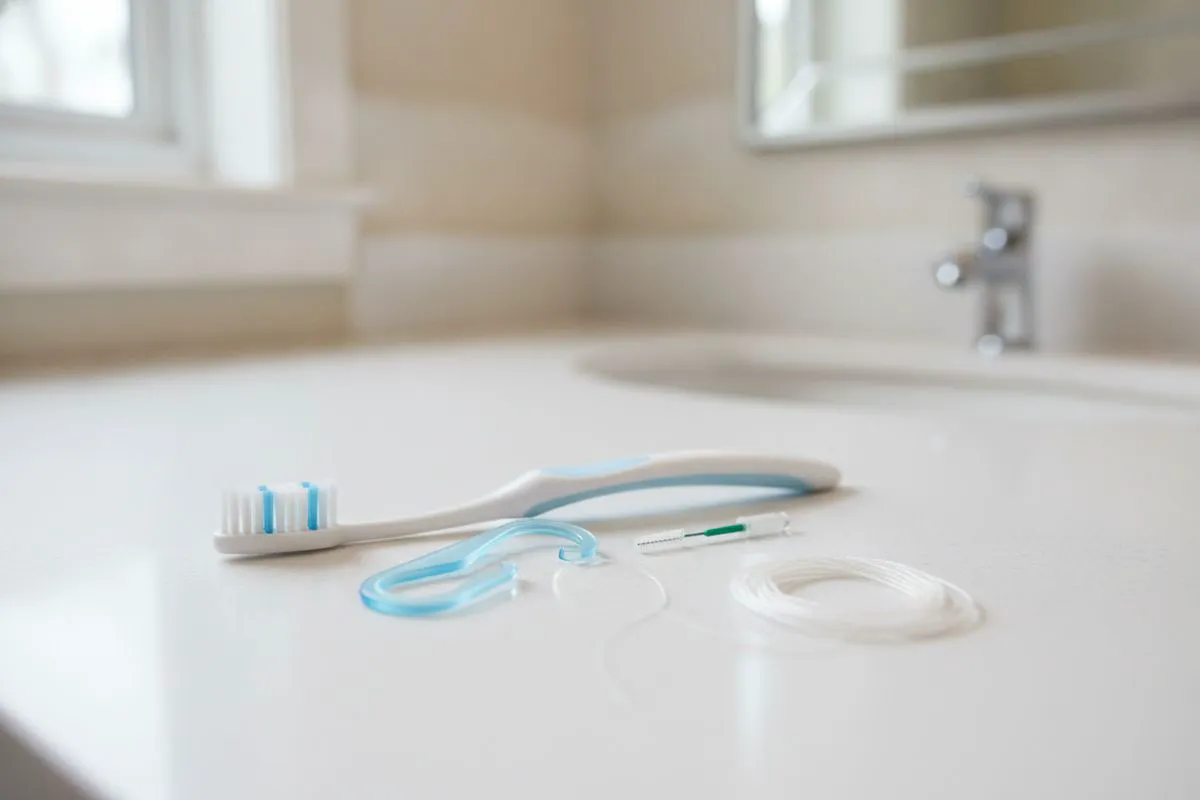
- Floss threader or tufted bridge floss. A stiff end carries floss under the pontic so you can sweep the underside. This is the usual first choice for a traditional fixed bridge.
- Interdental brush. A small brush can work when there is an open space next to an abutment. The brush should slide in without bending the wire hard against the gum.
- Water flosser. The ADA’s MouthHealthy page on water flossers notes that people with fixed bridges may use one because string floss is harder to pass. Use a low setting and aim along the gumline and under the pontic.
A water flosser does not automatically replace every other cleaner, and your dentist may still want floss or a small brush on a particular contact. If floss shreds in one spot, do not yank it, because shredding can mean a rough edge that should be polished rather than a reason to pull harder.
Step-by-step threader technique is covered in our guide on how to floss under a dental bridge. Use that page for the hand movements. This guide stays with the daily plan. Clean once a day, do it gently, and stop if a new routine causes more than a little bleeding.
Mild bleeding that fades after a few days of careful cleaning can be a sign the area was inflamed. Bleeding that continues, swelling, or a bad taste is a reason to call, so do not assume the bridge is “loose” just because the cleaner feels different. Let the office look before you change the routine on your own.
What Changes the Way You Clean
The right cleaning tool depends on the bridge design, the space underneath it, and how easily your hands can reach.
Not every bridge is cleaned the same way. A traditional bridge uses crowns on neighboring teeth, a cantilever uses support on one side, and an implant bridge is anchored to implants instead of natural teeth. Maryland-style bridges use wings bonded to nearby teeth, and each design leaves a different path for floss.
Use this as a starting point, then confirm it at an exam:
- New permanent bridge. Emphasize: Soft foods at first. Gentle brushing. Use the cleaner the office demonstrated. Ask the dentist: Ask when firmer foods are fine, and which tool fits this design.
- Temporary bridge. Emphasize: Clean very gently. A temporary is cemented more lightly. Ask the dentist: Ask if you should avoid floss that pulls up on the temporary.
- Tight contacts. Emphasize: Use threader floss. Do not force a thick brush. Ask the dentist: Ask if an edge needs smoothing when floss shreds.
- Open gum spaces. Emphasize: Use a sized interdental brush. Also brush the gumline. Ask the dentist: Ask which brush width to buy so the wire does not jab the tissue.
- Hard-to-reach pontic. Emphasize: Use a water flosser on a low setting. Then check for missed spots. Ask the dentist: Ask if water flossing is enough or should be added to floss.
- Limited hand mobility. Emphasize: Try a larger handle, a floss holder, or a water flosser. Ask the dentist: Ask for a hands-on demo and a simpler routine you can keep.
Implant-supported bridges still need the gum cleaned around the posts. The implant does not decay, but the tissue around it can become inflamed. If your bridge comes off for cleaning at visits, follow the home steps you were given for the fixed version you wear between appointments. Removable partials are a different appliance. Their care is closer to a denture routine than to a cemented bridge.
Habits That Protect the Bridge Between Visits
Skip ice and very sticky sweets, and tell your dentist if you clench or grind at night.
Home care is not only brushing. A bridge is strong, but the cement and the porcelain can chip or loosen when they take a sudden hard bite. Common trouble foods are ice, hard candy, popcorn kernels, and very sticky caramel or taffy. Cut apples, crusty bread, and tough meat into smaller pieces instead of biting straight through them with the pontic.
Sugary snacks and frequent sipping of sweet or acidic drinks feed the bacteria that attack abutment teeth. You do not need a special “bridge diet.” Use the same cavity habits you would use on natural teeth. Keep sweets with meals when you can, and brush before bed. For the first days after a bridge is placed, food texture matters more. Our separate guide to what to eat after getting a dental bridge covers that short window.
Tell the office if you clench or grind. A nightguard is sometimes used to spread that force, but only after someone checks your bite, so do not buy a boil-and-bite guard and assume it is safe over a new bridge. Sports with contact or a risk of a fall are another case for a mouthguard, and a custom guard can be made to fit around the restoration.
- Do not use your bridge to open packages or bite thread.
- If a temporary crown or bridge comes off, save it and call. Do not glue it with household adhesive.
- Smoking and vaping raise the chance of gum problems around the abutments. Quitting helps the tissue that supports the bridge.
Lifespan depends on the material, the bite, the gum, and home care. This page does not estimate how many years your bridge will last. That question is covered in how long a dental bridge lasts, and the answer still comes from an exam, not a chart.
When Should You Call the Dentist?
Call for looseness, a crack, swelling, bite pain, or any change you cannot clean comfortably.
Some tenderness after a new bridge is common for a short time, and it should ease rather than build. Call the office if you notice any of the following, even if you cannot tell the cause yet.
- The bridge feels loose, rocks, or catches your tongue in a new way.
- A chip, crack, or rough edge appears, or floss starts shredding in one place.
- Pain when you bite that lasts more than a day or two after placement.
- Swelling, a pimple on the gum, pus, or a bad taste near an abutment.
- Bleeding that continues after a week of gentle cleaning.
- A temporary bridge comes off, even if it does not hurt.
Looseness is not a do-it-yourself glue problem. Drugstore adhesives are not made for a fixed bridge and can leave residue that makes a later recement harder. If you are in pain, have swelling, or the bite suddenly feels very high, contact the office the same day. Hillcrest and nearby patients can use same-day emergency dentistry when the change cannot wait for a routine visit.
A high bite is worth a short adjustment visit. Waiting can make an abutment sore or loosen the cement. Bring a list of what you feel and when it started. That is more useful than trying to diagnose it online.

What Happens at a Bridge Checkup
The visit checks the bridge, the supporting teeth or implants, the surrounding gum, and the way you clean.
Home care does not replace professional visits. Many people are seen about every six months for an exam and cleaning, but that interval is a common starting point rather than a rule for every mouth. Gum disease, a high cavity risk, or a bridge that is hard to clean can mean shorter gaps between visits.
At a maintenance visit the team typically:
- Looks at the bridge for chips, open edges, and wear.
- Checks the bite and whether the bridge is stable.
- Examines the gum around the abutments and under the pontic.
- Cleans tartar you cannot remove at home.
- Takes X-rays when needed to look for decay under a crown or bone changes around an implant.
- Watches you clean the area and suggests a different tool if the current one is not reaching.
Restorative dentistry at the practice includes crowns and bridges along with other tooth repair. If a bridge no longer fits, the conversation may include repair, a new bridge, or another way to replace the tooth. Comparing a bridge with an implant is a planning question, not a home-care step. Read dental bridge and implant options only if you are deciding on treatment, not for the daily routine.
Gum bleeding around a bridge is often early inflammation. What gingivitis looks like can help you name the signs, but the fix is still an exam plus a cleaner you can use. Do not start a medicated rinse from a store shelf and skip the visit.
Marcos Ortega DDS has served Hillcrest and downtown San Diego for more than 34 years. Sedation is available for patients who feel anxious about dental visits. If cost is the reason you are delaying a repair, the financial options page describes payment help, including CareCredit. Terms depend on the lender and your approval. The office can review them at a visit. Nothing on that page promises interest-free financing.
Call (619) 295-4545 to request a bridge care visit
Frequently Asked Questions
Can I brush normally with a dental bridge?
Yes. Brush twice a day with a soft brush and fluoride toothpaste, including the gumline and the teeth that hold the bridge. Add a separate daily step under the pontic, because brushing alone usually misses that surface.
Can I use a water flosser under a bridge?
Often, yes. The American Dental Association notes that water flossers can help people with fixed bridges clean where string floss is difficult. Ask your dentist whether it should replace or add to floss for your bridge, and start on a low pressure.
How do I clean a temporary bridge?
Brush gently and follow the instructions from the visit. A temporary is cemented to come off later, so avoid pulling up on it with floss or eating very sticky foods. If it comes loose, save it and call. Do not recement it at home.
Does a bridge need special toothpaste?
Usually, no. A standard fluoride toothpaste and a soft brush are enough. Skip gritty whitening products on the bridge. If the color of the pontic no longer matches your other teeth, ask about polishing or replacement. Whitening gel does not change porcelain.
How often should a bridge be checked?
Many patients are seen about every six months. Come sooner for looseness, a chip, swelling, lasting bite pain, or bleeding that does not settle with gentle cleaning. The right interval depends on your gum health and how well you can clean the area.