
When one tooth is missing, a dental bridge and a dental implant can both restore your bite and fill the visible gap. The better choice depends on your neighboring teeth, gum and bone health, treatment preferences, timeline, and long-term care goals. This guide explains the practical differences so you can have a more informed conversation with your dentist in San Diego.
Schedule a personalized tooth-replacement consultation in San Diego.
Dental Bridge vs. Implant: What Is the Main Difference?
A dental bridge replaces a missing tooth by using neighboring teeth for support, while a dental implant replaces the missing tooth root with a post in the jaw and supports a crown. Both can restore chewing and appearance, but they involve different teeth, procedures, maintenance needs, and timelines. A dentist must evaluate your mouth before recommending either option.
A conventional fixed bridge usually includes an artificial tooth, called a pontic, attached to crowns that fit over the teeth next to the space. The supporting teeth are prepared so the bridge can fit securely.
A single-tooth implant has three main parts: an implant post, an abutment, and a dental crown. The post is placed in the jawbone, and the crown is attached after the site has healed enough for the planned restoration.
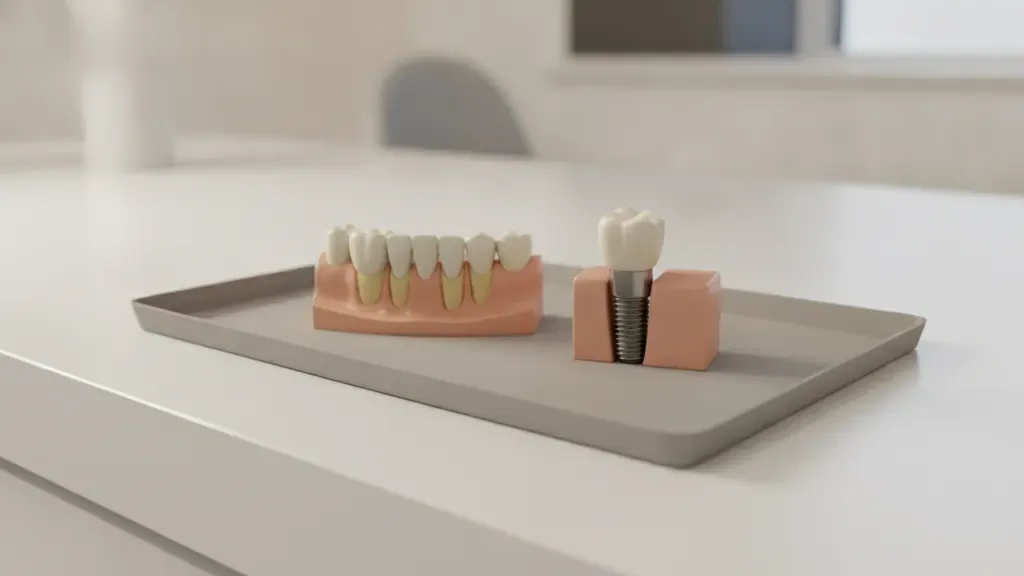
For general background, the American Dental Association’s MouthHealthy guide to bridges describes how bridges replace missing teeth, while its implant guide explains the role of implants in tooth replacement.
How Do Bridges and Implants Compare?
The most important comparison is not which treatment is universally best. It is which treatment fits your anatomy, the condition of nearby teeth, your comfort with surgery, and the type of maintenance you can manage. Use the summary below as a starting point, not as a diagnosis.
Support: A dental bridge uses neighboring teeth. A dental implant uses a post supported by the jawbone.
Surgery: A conventional bridge does not require implant placement. An implant requires surgical placement.
Nearby teeth: Bridge supports are prepared as part of treatment. Neighboring teeth can remain separate with a single-tooth implant.
Timeline: A bridge often involves fewer treatment visits. An implant includes healing before the final crown.
Cleaning: A bridge requires cleaning beneath the replacement tooth. An implant requires careful daily hygiene around the crown and gumline.
The right comparison also depends on whether you are replacing a front tooth or a back tooth, how much space is available, the condition of adjacent teeth, and whether you have active gum disease or other oral health concerns. These details are why an online comparison cannot select a treatment safely on its own.
What Can Change the Recommendation?
The condition of the teeth, gums, bone, and bite can change which replacement options are reasonable. A dentist may recommend treating gum inflammation, repairing a neighboring tooth, or allowing an extraction site to heal before finalizing a bridge or implant plan. These steps are not signs that treatment has failed. They are part of protecting the tissues that will support the restoration.
- Adjacent teeth: A bridge depends on the teeth beside the space, so cracks, large fillings, decay, or weakened roots may affect whether they are suitable supports.
- Gum health: Active gum disease can affect the tissues around both a bridge and an implant. Stabilizing the gums may come first.
- Bone volume: An implant needs a stable site in the jaw. If bone has changed after tooth loss, the dentist may discuss bone preservation or grafting.
- Bite and spacing: Clenching, limited room, tooth movement, and the position of the opposing teeth can affect the design and loading of a restoration.
- Health history: Medications, healing considerations, and tobacco use should be reviewed openly before any surgical or restorative treatment.
These factors also explain why two people with a missing tooth may receive different recommendations. A careful plan protects the remaining teeth and helps set realistic expectations for comfort, appearance, function, and maintenance.
When Might a Dental Bridge Fit Your Goals?
A dental bridge may be worth discussing when the teeth beside the gap are strong enough to support it, you prefer a treatment that does not involve implant placement, or you want to restore the space with a smaller number of visits. The bridge uses the existing teeth as anchors, so those teeth become part of the treatment plan.
Potential advantages of a bridge
- Familiar support structure: The replacement tooth is held by crowns fitted over adjacent teeth.
- No implant post: A conventional bridge does not require a post placed into the jawbone.
- Potentially shorter sequence: A bridge may be completed with fewer stages than an implant and crown, depending on the case.
- Restored daily function: A well-designed bridge can help restore chewing and speaking after tooth loss.
Important bridge considerations
- The supporting teeth must be evaluated because they will carry the bridge.
- Preparing otherwise healthy teeth is a meaningful tradeoff to discuss.
- Food and plaque can collect around or beneath the restoration if it is not cleaned carefully.
- A bridge is not a permanent guarantee. Its service life depends on fit, bite, gum health, home care, and professional maintenance.
Marcos Ortega DDS provides restorative dentistry in San Diego for patients comparing options for missing teeth. Your consultation can include questions about the condition of the teeth that would support a bridge and how the restoration would fit your bite. If the supporting tooth also needs protection, you can ask about dental crowns in San Diego as part of the wider plan.
When Might a Dental Implant Fit Your Goals?
A dental implant may fit patients who want a replacement that is supported by the jaw rather than by neighboring teeth and who are candidates for implant placement and healing. The evaluation may include gum health, available bone, bite forces, medical history, and the condition of the extraction site or missing-tooth area.
Potential advantages of an implant
- Root replacement: The implant post is designed to replace the root portion of a missing tooth.
- Independent support: A single-tooth implant does not require crowns on adjacent teeth for support.
- Natural tooth spacing: The implant crown fills the gap while the neighboring teeth remain separate restorations.
- Long-term planning: The implant and crown can be maintained as part of an ongoing preventive care plan.
Important implant considerations
- Implant placement is a surgical procedure, and suitability must be determined through an exam.
- Healing takes time before the final crown can be placed, and the overall timeline varies.
- Some patients need additional preparation, such as bone grafting, before or during implant treatment.
- An implant crown still needs daily cleaning and professional follow-up. It is not immune to gum inflammation or other complications.
For additional context, the American Dental Association’s patient resource on dental implants discusses implants as one option for replacing missing teeth. Marcos Ortega DDS also offers dental implant treatment in San Diego and can explain the steps, imaging, comfort options, and restoration plan during a consultation.
Which Option Takes Longer: A Bridge or an Implant?
A bridge is often completed in a shorter treatment sequence, while an implant generally takes longer because the implant site needs time to heal before the final crown is attached. The actual timeline depends on whether a tooth needs to be removed, whether the gums or bone need treatment, and how the restoration is designed.
- Evaluation: Your dentist examines the missing-tooth area, adjacent teeth, gums, bite, and available space.
- Planning: The team discusses whether a bridge or implant is technically appropriate and what preparation is needed.
- Tooth replacement: A bridge is fitted to prepared supporting teeth. An implant is placed into the jaw and allowed to heal before restoration.
- Final restoration: The replacement tooth is adjusted for appearance, speech, comfort, and function.
- Maintenance: Follow-up visits and home care help protect the restoration and the surrounding tissues.
Treatment timing should be weighed alongside your health and priorities. A faster initial sequence is not automatically the best long-term fit, and a longer implant process is not appropriate for every patient.
Ask Marcos Ortega DDS which tooth-replacement options may fit your goals.
How Should You Clean a Bridge or Implant?
Both restorations need daily brushing, careful cleaning at the gumline, and professional checkups, but the cleaning technique differs because a bridge has a connected underside while an implant crown has its own gumline. Your dental team can demonstrate the tools and technique that fit your restoration and your oral health.
Cleaning around a bridge
- Brush the bridge and the surrounding teeth with a soft-bristled toothbrush.
- Use floss threaders, an interdental brush, or another recommended method to clean beneath the pontic.
- Pay attention to the gumline around each supporting tooth.
- Report bleeding, persistent tenderness, looseness, or a change in your bite.
Cleaning around an implant crown
- Brush the crown and gumline gently but thoroughly.
- Clean around the implant with the floss or interdental tool recommended for your anatomy.
- Keep regular hygiene visits so the gums and restoration can be checked.
- Report swelling, bleeding, discomfort, movement, or a loose crown or component.

Good home care protects more than the replacement tooth. It also supports the teeth, gums, and bone around the restoration. If you are nervous about treatment or have delayed dental care because of anxiety, ask about the comfort approach before scheduling a procedure. Marcos Ortega DDS has a comfort-focused practice and DOCS-certified sedation experience, with suitability assessed for each patient.
How Do You Decide Between a Dental Bridge and Implant?
The decision should combine clinical findings with your priorities rather than rely on a single rule. Bring the following questions to your consultation:
- Are the teeth next to the space healthy and strong enough to support a bridge?
- Do I have enough bone and gum health for an implant, or would preparation be needed?
- How do the treatment stages and healing period fit my schedule?
- How will each option affect daily cleaning?
- What will the full treatment plan include, and which parts depend on my exam findings?
- What comfort or sedation options are appropriate for me?
- How will the restoration be maintained over time?
Cost can also be part of the discussion, but a responsible estimate requires an evaluation. Materials, preparation, imaging, the number of visits, insurance benefits, and the condition of your teeth and gums can all affect the plan. A consultation helps you compare the full process instead of comparing an incomplete starting figure.
Marcos Ortega DDS has served San Diego for more than 34 years and provides restorative care, cosmetic dentistry, and comfort-focused sedation in one practice. The office offers a no-pressure consultation approach, free parking, and treatment planning that accounts for your concerns and goals.
Frequently Asked Questions
Is a dental bridge or implant better for one missing tooth?
Neither option is better for every patient. A bridge may suit someone whose neighboring teeth can support it and who prefers a shorter treatment sequence. An implant may suit someone who is a candidate for implant placement and wants independent support. An exam is needed to compare the options safely.
Is a dental bridge less invasive than an implant?
A conventional bridge does not require implant surgery, while an implant requires surgical placement into the jawbone. A bridge still involves preparing the supporting teeth, so less surgery does not mean less treatment for every patient. Your dentist can explain the tradeoffs for your mouth.
Can an implant replace a bridge?
An implant can be used as an alternative to a conventional bridge in some situations, but the appropriate choice depends on the number and location of missing teeth, bone, gum health, and the condition of the neighboring teeth. Some patients may also discuss implant-supported bridge options.
How long does it take to get a bridge or implant?
A bridge is often completed in fewer stages, while an implant usually includes a healing period before the crown is placed. The timeline varies with tooth removal, bone or gum treatment, laboratory steps, and individual healing. Ask for a written sequence at your consultation.
How much does a dental bridge or implant cost?
There is no responsible single price for either treatment without an exam. The estimate may include preparation, imaging, the restoration, laboratory work, follow-up, and insurance considerations. Marcos Ortega DDS can review your treatment options and explain the factors that shape your personalized estimate.
Plan Your Tooth-Replacement Consultation in San Diego
A dental bridge and a dental implant can both help replace a missing tooth, but they solve the problem in different ways. The best next step is a careful evaluation of your neighboring teeth, gums, bone, bite, health history, timeline, and comfort preferences.
Contact Marcos Ortega DDS to plan a no-pressure consultation about a dental bridge or implant.
Whether you are in Hillcrest, Mission Hills, Banker’s Hill, or Downtown San Diego, a personalized conversation can help you understand your options and choose a plan that supports your health and daily life.