
Choosing an orthodontic treatment is about more than whether you prefer clear plastic or metal brackets. San Diego patients also need to consider how discreet the treatment should be. How consistently they can follow it, the complexity of the tooth movement, and what fits their comfort level.
Schedule a free Invisalign consultation in San Diego today and learn which orthodontic option matches your goals.
Invisalign vs braces San Diego comparisons usually come down to lifestyle and clinical needs: clear aligners are removable and discreet. While traditional braces provide fixed, continuous guidance that may be better suited to some complex movements. Both can be effective, but the right choice depends on an exam, oral health, treatment goals, and your willingness to follow the recommended wear or care routine.
A thoughtful consultation can clarify those tradeoffs without pressure, especially for adults who have delayed care because of appearance concerns or dental anxiety. The following comparison looks at the practical differences first, then explains how they may affect cost, timing, daily routines, and suitability.
Invisalign vs Braces in San Diego: Key Differences at a Glance
Invisalign and traditional braces can both address many alignment concerns, but they create movement in different ways and place different responsibilities on the patient. Clear aligners are transparent, removable trays replaced periodically to gradually guide teeth into position. Braces use brackets and wires that remain in place, applying continuous pressure throughout treatment. Research supports both approaches for malocclusion, while also showing that their clinical strengths are not identical. Review the research on clear aligners and braces for additional context.
When comparing Invisalign vs braces San Diego patients should consider these core differences: Invisalign uses removable transparent trays that are swapped every few weeks. While braces use fixed brackets and wires for continuous pressure. Invisalign is generally preferred for mild to moderate cases where discretion matters, while braces may offer more controlled force for complex tooth movements. Your specific oral health and treatment goals will determine which approach a dentist recommends.
| Consideration | Invisalign | Traditional braces |
|---|---|---|
| Appearance | Transparent aligners are generally a discreet option. | Metal brackets and wires are more noticeable, though they are a reliable, time-tested approach. |
| How it works | A series of custom aligners is replaced every few weeks to guide planned tooth movements. | Brackets and wires apply constant pressure and can provide control for complex movements. |
| Removability | Removable for meals, drinks other than water, brushing, and flossing. | Fixed during treatment, so food choices and cleaning require adjustments. |
| Checkup frequency | Regular visits monitor progress and support safe, effective treatment. | Regular visits monitor progress and allow adjustments to the appliance. |
| Compliance requirements | Aligners need to be worn for the prescribed daily schedule, commonly 20 to 22 hours, to work as planned. | Because the appliance stays in place, daily wear compliance is less dependent on remembering to put it in. |
| Best for | Many mild to moderate alignment concerns, especially when discretion and removability matter. | Many alignment concerns, including cases that benefit from constant force or more complex tooth control. |
Neither option is automatically better for every patient. An exam considers oral health, the type and complexity of tooth movement needed, and your priorities for appearance and daily care. Some patients value the discreet routine of Invisalign, while others prefer the dependable fixed design of traditional braces. A consultation can clarify which approach fits your goals and how regularly you will need to return for monitoring.
Cost Comparison: Invisalign vs Braces in San Diego
Cost is an important part of comparing Invisalign and braces, but the lowest starting estimate is not always the best guide. Your total depends on the degree of tooth movement needed, the length of treatment, the number of visits, and whether additional attachments or procedures are recommended. A comprehensive exam is the only reliable way to turn a general range into a treatment-specific estimate.
In San Diego, Invisalign typically ranges from about $4,000 to $8,000 while traditional braces commonly range from about $3,000 to $7,000. Your actual fee depends on treatment complexity, duration, and the appliances required. Insurance may cover roughly 50 percent of orthodontic treatment or provide a lifetime benefit of up to about $3,000, though coverage varies by plan and age limits. A consultation gives you a personalized estimate and lets you review available payment options.
Typical price ranges
- Traditional braces: Generally $3,000 to $7,000 depending on case complexity and treatment length.
- Invisalign: Typically $4,000 to $8,000 depending on the number of aligners needed and duration.
- Insurance contribution: Many plans cover orthodontic treatment at about 50 percent or up to $3,000 lifetime maximum.
These figures are general planning ranges, not a quote for an individual patient. A straightforward alignment case may cost less than a complex bite correction, while a longer treatment plan may require more appointments and materials.
For a closer look at the factors that influence pricing, see our guide to Invisalign cost in San Diego. It can help you prepare questions before your consultation, including what is included in the treatment fee and whether retainers, refinements, or follow-up care are covered.
How dental insurance may affect the difference
Many dental insurance plans treat Invisalign coverage similarly to traditional braces. Depending on the policy, the plan may cover approximately 50 percent of orthodontic treatment or provide a lifetime orthodontic benefit of up to about $3,000. Coverage varies by age limits, deductibles, waiting periods, exclusions, and whether the provider participates in the plan. Ask your insurer for the benefit details in writing, then compare that information with the practice’s estimate.
Insurance may reduce the difference between the two options, but it may not cover every related expense. Before starting, ask whether your plan includes both aligners and braces, how refinements are handled, and whether retainers are part of the quoted fee. You can also discuss payment arrangements that make the remaining balance easier to manage.
Start with an individualized estimate
Marcos Ortega DDS offers a free Invisalign consultation for patients considering clear aligners. During the visit, the team can review your goals, examine your oral health, explain whether Invisalign or braces is appropriate, and outline expected costs without pressure. You can also explore Invisalign treatment options before scheduling. Treatment recommendations depend on exam findings, oral health, and your goals, so a personalized evaluation is more useful than choosing based on a price range alone.
Treatment Timeline: How Long Does Each Option Take?
Treatment timelines for Invisalign vs braces San Diego patients can expect to vary based on the complexity of tooth movement needed and how consistently the treatment plan is followed. Braces commonly take 12 to 24 months, while Invisalign may be faster for some mild to moderate cases, often ranging from 9 to 18 months. Consistent wear of aligners for 20 to 22 hours daily is critical for staying on schedule.
Typical timelines by case complexity
- Minor concerns: Braces may take about 6 to 12 months, while Invisalign may take approximately 3 to 9 months.
- Moderate concerns: Braces commonly fall in the 12- to 18-month range. Invisalign may take about 9 to 15 months.
- Complex concerns: Braces may require 18 to 24 months, while Invisalign may take approximately 15 to 21 months.
These ranges are planning estimates, not guarantees. Orthodontic treatment time varies significantly with the complexity of the malocclusion, as noted by the Mayo Clinic. Invisalign can be faster for some mild-to-moderate cases, particularly when the planned tooth movements are well suited to clear aligners. Traditional braces may be more efficient when a case requires extensive control or constant force. Your exam findings, oral health, and treatment goals help determine which approach is appropriate.
Why daily follow-through matters
With braces, the appliances remain fixed throughout treatment, so progress does not depend on remembering to put them back in. Invisalign requires active participation. Aligners generally need to be worn about 20 to 22 hours each day, removed for meals and drinks other than water, and replaced as directed. Missing wear time can slow progress and may require adjustments to the treatment plan. Compliance is especially important when comparing Invisalign vs braces San Diego patients may be considering for a busy schedule.
Regular visits allow the dental team to check movement and make sure treatment is progressing safely. To explore whether you may be a candidate, review Invisalign treatment in San Diego and schedule an individualized consultation.
Aesthetics, Comfort, and Daily Life
For many adults, the practical differences between Invisalign and braces matter as much as the expected tooth movement. Invisalign aligners are transparent, so they offer a discreet option for patients who want orthodontic treatment to draw less attention. This can be especially appealing to professionals and adults who have delayed care because of appearance concerns. Research also indicates that patients often prefer clear aligners for their comfort and esthetics compared with conventional fixed brackets (clinical research on clear aligners and braces).
There is no single winner for comfort. Invisalign offers the freedom to remove aligners for eating and cleaning, but requires daily discipline. Braces provide predictable force without relying on patient memory, but require dietary restrictions and more careful cleaning. Patients who prioritize discretion and flexibility tend to prefer Invisalign, while those who want a set-it-and-forget-it approach often choose braces. An exam helps you weigh these tradeoffs against your oral health needs.
Eating and brushing
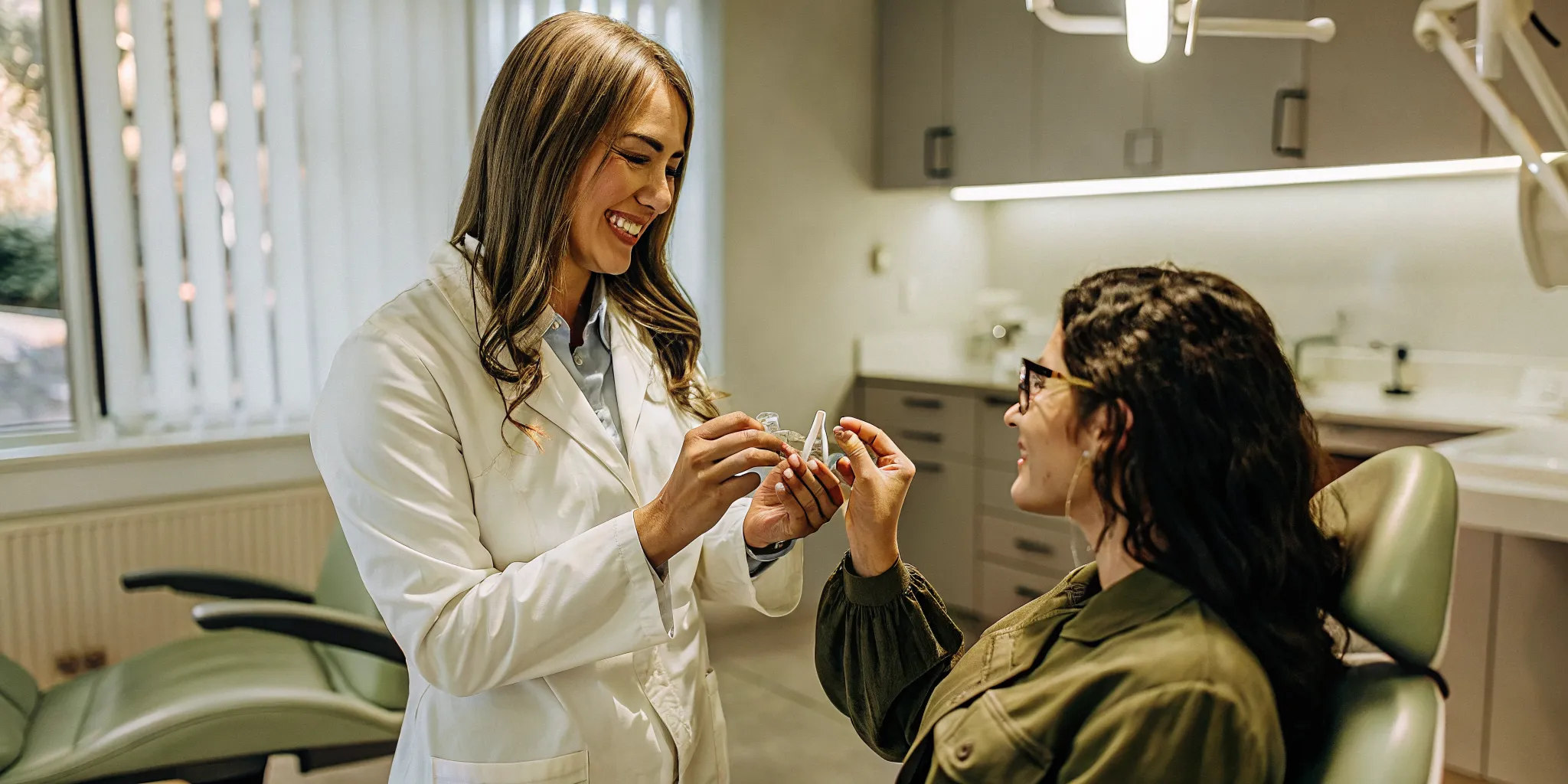
Invisalign aligners are removable for meals and for brushing. You can generally take them out before eating, then clean your teeth and place them back as directed. That flexibility lets you continue eating your usual foods without navigating around brackets or wires. Removable aligners may also make daily oral hygiene easier because you can brush and floss the tooth surfaces directly, rather than working around fixed hardware (Mayo Clinic guidance on orthodontic treatment).
Traditional braces stay in place throughout treatment. Patients may need to limit or avoid hard, sticky, or chewy foods that can damage brackets or wires. Brushing and flossing remain important, but cleaning takes additional care around each bracket and beneath the wire. For some patients, the fixed design is reassuring because there is no aligner to remember to wear or remove.
Comfort in your routine
Clear aligners do not use metal brackets and wires, and they are often considered more comfortable for that reason. Patients can still notice pressure or temporary tenderness as teeth begin responding to treatment, so an exam and personalized plan are important. Braces can also be managed successfully, although brackets and wires may cause irritation while your mouth adjusts. Your provider can explain what to expect and suggest appropriate ways to handle discomfort.
Invisalign may fit easily into work, social, and active routines, but it requires consistent wear and responsible care. Clear or ceramic braces can provide a middle-ground aesthetic choice for patients who prefer a fixed appliance. To compare another discreet option, see this guide to clear braces San Diego adults may consider.
Support for anxious patients
The appointment experience matters when anxiety has already delayed orthodontic care. At Marcos Ortega DDS, DOCS-certified oral conscious sedation may be considered for patients who need help managing anxiety during longer orthodontic appointments. Sedation is not appropriate for everyone, so suitability, screening, and monitoring should be discussed with the dental team. A comfort-first conversation can help you compare Invisalign and braces without pressure and choose a plan based on your oral health, goals, and daily routine.
Which Orthodontic Issues Can Each Treatment Address?
The key consideration when comparing Invisalign vs braces San Diego patients should understand is that each method handles different types of tooth movement. Invisalign is typically well suited for mild to moderate crowding, spacing, and certain bite issues. Traditional braces often provide better control for severe rotations, complex bite corrections, and cases requiring precise torque control. Your specific bite pattern and treatment goals determine which approach a dentist will recommend.
When Invisalign may be a good fit
Clear aligners are often well suited to mild-to-moderate alignment concerns, including gaps, mild crowding, and certain cases of rotated or uneven teeth. They move teeth through a planned series of removable aligners, and some more involved cases may use small attachments to improve control. Because aligners are removable, success also depends on wearing them as directed and returning for progress checks.
For adults who want a discreet option, Invisalign may address functional concerns while fitting more easily into professional and social routines. That does not mean it is appropriate for every case. The complexity of the tooth movements matters more than appearance alone.
When traditional braces may offer more control
Braces can be a better option when treatment requires complex tooth movement, severe rotations, precise torque control, or more consistent force. Fixed brackets and wires remain attached throughout treatment, which can help manage cases where patient compliance with removable appliances would be difficult. Traditional braces are also a well-established choice when bite correction requires coordinated movement across several teeth.
Both Invisalign and braces may be used to address overbites, underbites, crossbites, and open bites. However, the treatment approach and expected level of control can vary significantly from one patient to another. Research reviews have found that both methods can be effective for malocclusion. While braces may have advantages for some complex movements, including torque control and achieving stable tooth contacts.
At Marcos Ortega DDS, a comprehensive exam helps determine which option is appropriate. The evaluation considers your bite, tooth position, gum and dental health, and treatment goals rather than matching every patient to the same appliance. If you are comparing San Diego orthodontist services, ask how the proposed treatment will address your specific movements and bite relationship.
Frequently Asked Questions
Which is better, Invisalign or traditional braces?
Neither option is best for every patient. Invisalign may suit mild to moderate crowding, spacing, or bite concerns when you can wear the aligners as directed. Traditional braces may offer more control for complex tooth movements or significant bite correction. An examination and discussion of your goals can help determine which approach fits your needs.
How much do Invisalign and braces cost in San Diego?
Published San Diego treatment estimates commonly place traditional braces around $3,000 to $7,000 and Invisalign around $4,000 to $8,000. But your actual fee depends on treatment complexity, duration, and the appliances required. A consultation gives you a personalized estimate and lets you review available payment or insurance options.
How long does Invisalign take compared with braces?
Timelines vary with the amount and type of movement needed. Braces often take about 12 to 24 months, while Invisalign may be faster for some mild to moderate cases. Aligners generally need to be worn 20 to 22 hours each day, so consistent wear is an important part of staying on schedule.
Are clear braces the same as Invisalign?
No. Clear or ceramic braces are fixed appliances that use tooth-colored brackets and wires. Invisalign uses a series of removable, clear plastic aligners. Both can be less noticeable than traditional metal braces, but they differ in removability. Cleaning, eating habits, and the types of tooth movement they may be suited to address.
Does insurance cover Invisalign or braces?
Many dental plans contribute toward orthodontic treatment, although benefits vary by plan, age limits, deductibles, and lifetime maximums. Some San Diego sources report coverage of up to about $3,000 or roughly 50 percent for either option, but you should verify the details directly with your insurer. The dental office can help you review your estimated benefits before treatment begins.
Ready to Compare Your Invisalign Options?
A consultation can help connect your orthodontic goals, daily routine, and comfort preferences with an appropriate treatment plan. Schedule a free Invisalign consultation by contacting Marcos Ortega DDS online. You can ask questions about aligners, traditional braces, and what an examination may reveal about your choices, without committing to a treatment decision before you understand your options.