
Jaw soreness, facial tension, clicking, or a bite that suddenly feels different can make everyday activities uncomfortable. If you are looking into TMJ treatment in San Diego, a dental evaluation is a useful first step because it can organize the symptoms, examine how the jaw is moving, and clarify which options may be reasonable for your situation. It does not mean every jaw symptom has the same cause, and an online article cannot diagnose you.
Schedule a TMJ consultation in San Diego
What does TMJ mean, and why does an evaluation matter?
A TMJ evaluation looks at the jaw joints, chewing muscles, teeth, and bite together rather than treating one symptom in isolation.
TMJ is commonly used to describe the temporomandibular joints, the paired joints just in front of the ears that connect the lower jaw to the skull. Dental professionals may use TMD, or temporomandibular disorders, for problems involving the joints, the muscles used for chewing, or both. These problems can vary considerably from person to person.
For example, a painless click may not require treatment, while persistent pain, limited movement, or a change in how the teeth meet deserves an examination. Jaw discomfort can also overlap with tooth problems, muscle tension, sinus or ear symptoms, headaches, and other conditions. A careful evaluation helps separate what can be assessed in the dental setting from what may call for medical or specialist follow-up.
The goal is not to force every symptom into a TMJ label. It is to answer practical questions such as:
- Where is the discomfort located, and when did it begin?
- Does chewing, yawning, stress, or waking up make it worse?
- Is the jaw opening, closing, or moving side to side differently?
- Are there tooth, gum, ear, neck, or headache concerns that should be considered too?
For general background, the National Institute of Dental and Craniofacial Research overview of TMD explains that these conditions include multiple disorders rather than one single disease.
Which symptoms should prompt a dental evaluation?
Persistent or recurring symptoms, especially those that affect eating, speaking, sleeping, or opening the mouth, are worth discussing with a dental professional.
People seek an evaluation for many different combinations of symptoms. One person may notice tenderness near the jaw joint, while another notices tired chewing muscles or morning tightness. Symptoms alone cannot identify the cause, but they can help a dentist decide what to examine more closely.
- Pain or tenderness near one or both jaw joints
- Soreness in the cheeks, temples, or muscles used for chewing
- Difficulty opening the mouth fully or a jaw that occasionally catches
- Clicking, popping, or grating sounds, particularly when paired with pain or limited movement
- Jaw fatigue during meals or discomfort when biting and chewing
- Frequent clenching or grinding, whether noticed during the day or reported by a sleep partner
- A bite that feels different or teeth that no longer meet as they used to
A symptom diary can make the appointment more productive. Note the location, timing, triggers, duration, recent dental work, injuries, stress, and any habits such as gum chewing or holding the teeth together. Bring a list of medications and relevant medical or dental history. Do not try to reproduce painful movements repeatedly at home.
What happens during a TMJ evaluation?
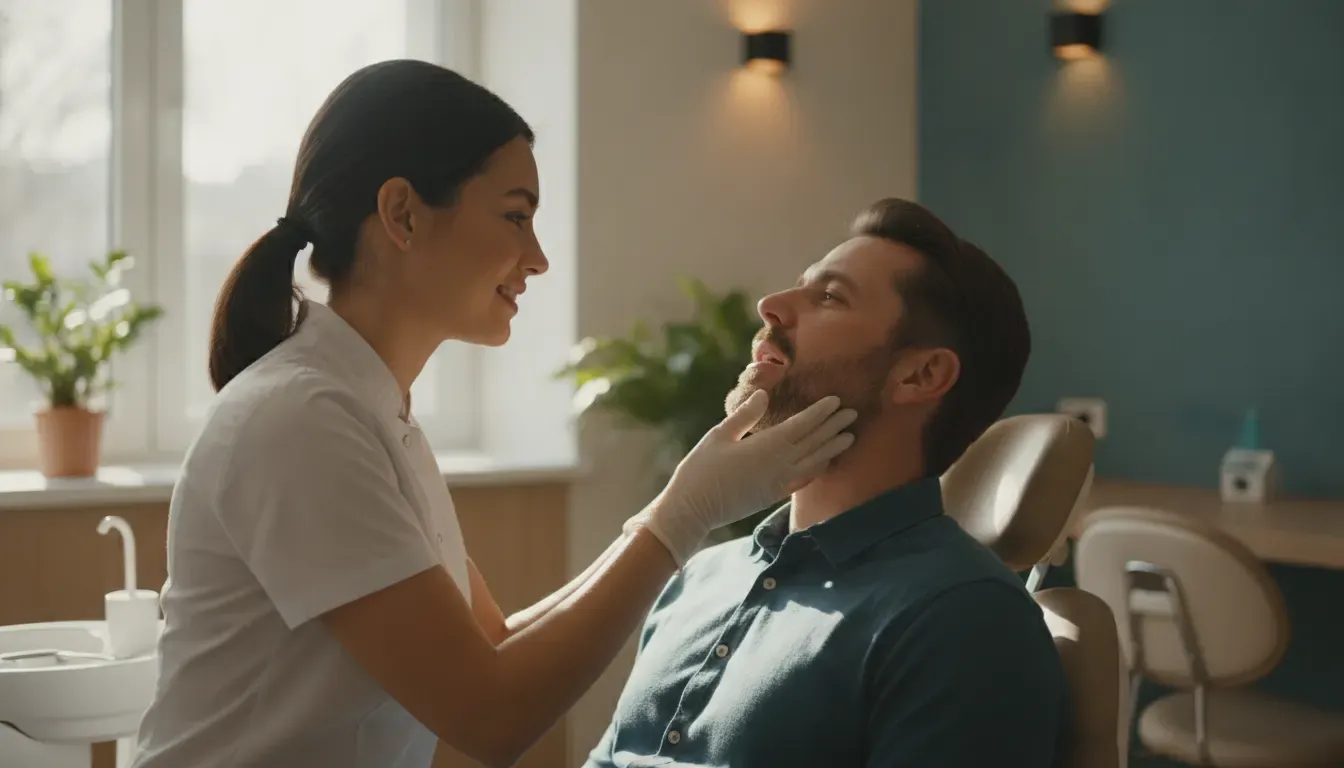
The appointment usually combines a conversation about symptoms with a focused examination of jaw movement, muscles, teeth, and the way the bite comes together.
1. A detailed symptom and health history
The dentist may ask when symptoms started, whether they are constant or intermittent, and what makes them better or worse. Questions may cover chewing, yawning, sleep, stress, clenching, prior trauma, dental procedures, headaches, neck tension, and medications. This context matters because jaw discomfort can be influenced by more than the joint itself.
2. Jaw movement and muscle examination
The dentist may observe how far the mouth opens, whether the lower jaw tracks evenly, and whether movement is comfortable. Gentle palpation can help identify tenderness in the jaw joints and chewing muscles. The evaluation may also consider whether movement is limited, deviates to one side, or produces a sound.
These findings are not interpreted in isolation. A joint sound without pain or reduced function may have a different significance from a painful or restricted movement. The dentist should explain what was observed and what remains uncertain.
3. Teeth, gums, and bite assessment
The teeth and supporting tissues can contribute to pain or reveal signs of clenching and grinding. A dentist may look for cracked or sensitive teeth, worn areas, uneven contacts, restorations that need attention, and changes in the way the upper and lower teeth meet. A bite finding is one part of the evaluation, not automatically proof that the bite caused every symptom.
4. Imaging when the findings support it
Imaging is not necessary for every person with jaw discomfort. If the history and examination suggest that a closer look at the teeth, jaw bones, or joint structures would be useful, the dentist may recommend an appropriate image or referral. The type of imaging depends on the clinical question. A scan should support a treatment decision, not replace a conversation and physical examination.
How can an evaluation clarify treatment options?
A good treatment discussion matches the level of care to the findings, symptoms, goals, and risk of making a problem worse.
There is no single TMJ treatment that is right for everyone. Some symptoms may be monitored with education and conservative care. Other situations may call for a custom oral appliance, coordination with a physical therapist or physician, dental treatment for a separate tooth problem, or additional evaluation. The plan should be explained in terms a patient can understand, including what the treatment is intended to address and how progress will be assessed.
Conservative care and daily habits
Depending on the examination, a dentist may discuss temporary changes that reduce strain while the jaw is irritated. These can include choosing easier-to-chew foods for a short period, avoiding extreme opening such as very wide yawning, limiting gum chewing, and noticing daytime clenching. Heat, cold, stretching, or medication may be appropriate for some people, but patients should follow individualized instructions and check with their healthcare professional before using medication, especially when they have other health conditions or take prescriptions.
Custom oral appliance therapy
A custom oral appliance may be considered when the examination suggests it could help manage certain jaw or muscle concerns. It should be designed, fitted, and monitored for the individual. A device is not a universal cure, and a poorly fitting or unsupervised appliance may not be appropriate. Ask what the appliance is designed to do, how long it is expected to be worn, and how the dentist will check its fit and effect.
Related dental, medical, or supportive care
Sometimes jaw symptoms occur alongside a cracked tooth, gum problem, sleep concern, neck tension, migraine, or another issue that needs a different type of care. A dentist may recommend treating the dental source, coordinating with another clinician, or referring for additional evaluation. If anxiety makes dental care difficult, comfort planning can be discussed before treatment. Marcos Ortega DDS has a long-standing focus on comfort-first dentistry and DOCS-informed sedation care, but sedation suitability is determined through screening and is not automatic.
A treatment plan should be specific about the next decision. It may recommend observation, a focused conservative step, a follow-up examination, or further testing. Be cautious about any plan that promises a guaranteed cure, assumes every symptom comes from the bite, or recommends irreversible changes without a clear examination-based reason and discussion of alternatives.
Talk with our San Diego dental team about your jaw symptoms
What should you ask before starting TMJ treatment?
Clear questions help you understand what the evaluation found, what a proposed treatment is intended to change, and when the plan should be reassessed.
- What findings may explain my symptoms, and what remains uncertain?
- Are my teeth, chewing muscles, jaw joints, or another concern involved?
- What is the least invasive reasonable next step for my situation?
- What should I expect the treatment to help with, and what can it not address?
- How will we monitor comfort, jaw movement, bite changes, or appliance fit?
- What alternatives are available if the first step does not help?
- Would another dental, medical, or physical therapy evaluation be appropriate?
These questions are useful whether you are visiting a general dentist, a dentist with TMJ experience, or a specialist. A consultation should leave you with a clearer understanding of the findings and a reasonable next step, not pressure to commit before you have enough information.

When should jaw pain be evaluated urgently?
Severe, rapidly changing, or function-limiting symptoms should not wait for routine content research or self-treatment.
Contact a dental or medical professional promptly after facial or jaw trauma, when swelling or fever is present, or when you cannot open or close your mouth normally. Difficulty breathing or swallowing, new facial weakness or numbness, or severe pain that is rapidly worsening requires urgent medical attention. A dentist can help determine the appropriate next step, but emergency symptoms should not be managed through an online TMJ checklist.
Why choose a comfort-focused San Diego dental evaluation?
Patients deserve a careful explanation of what was found and a treatment conversation that respects comfort, goals, and individual health needs.
Marcos Ortega DDS has served the San Diego community for more than 34 years, with a practice model that brings general, restorative, cosmetic, and comfort-focused services together. The office serves patients from Hillcrest, Mission Hills, Banker’s Hill, Park West, Middletown, and Downtown San Diego. An evaluation can be planned around your concerns, with digital diagnostic tools and patient education used when appropriate.
For patients who feel nervous about dental care, it is reasonable to discuss comfort needs before an examination. The practice’s DOCS sedation expertise, UCSF DDS background, and involvement in cosmetic dentistry through the AACD support an individualized conversation, while the actual treatment recommendation depends on the examination and patient goals. Free parking and a no-pressure consultation approach can make it easier to take the first step.
Learn more about our dental services, explore sedation dentistry for anxious patients, or review our practice background before your visit.
Request a TMJ evaluation with Marcos Ortega DDS
Frequently asked questions about TMJ treatment in San Diego
Can a dentist diagnose the cause of my jaw pain?
A dentist can evaluate the teeth, jaw joints, chewing muscles, bite, and related symptoms, then explain what those findings may indicate. Some symptoms overlap with medical or neurological conditions, so a dentist may recommend coordination with another healthcare professional when appropriate.
Is a clicking jaw always a sign that I need TMJ treatment?
No. Clicking or popping can occur without pain or loss of function and does not automatically require treatment. Persistent pain, limited movement, locking, or a meaningful change in function deserves a professional evaluation.
Will I need a scan during a TMJ evaluation?
Not necessarily. Imaging depends on the history and examination. If imaging could clarify the teeth, bones, or joint structures relevant to a treatment decision, the dentist can explain which type is appropriate and why.
What is the first step if I am nervous about TMJ care?
Request a consultation and tell the team about your concerns before the appointment. A discussion can clarify what the evaluation involves, answer questions about comfort, and determine whether sedation screening or another accommodation is appropriate. Treatment and sedation recommendations depend on your health history and examination.
Jaw discomfort can be frustrating, but you do not have to decide on treatment based on symptoms alone. A careful dental evaluation can clarify what is being observed, identify reasonable conservative next steps, and show when another type of care may be needed.