
Replacing a missing tooth involves more than choosing a familiar office. Your provider should be able to evaluate your oral health, explain the treatment sequence, discuss comfort options, and coordinate the final restoration with careful attention to your goals.
Choosing a dental implants dentist means looking for relevant credentials, experience with both implant placement and restoration, appropriate imaging and technology, and a clear plan for follow-up care. A thorough consultation should leave you informed about candidacy, timing, sedation options, and the type of restoration that may fit your needs.
At Marcos Ortega DDS, patients in Hillcrest, Downtown San Diego. And nearby communities can discuss implant care with a practice that has served San Diego for more than 34 years. The office provides comprehensive surgical and restorative services in-house, along with comfort-focused options for patients who feel anxious about treatment.
Request a free dental implant consultation to discuss your options.
The right choice becomes easier to assess when you understand what quality implant care should include, from professional training to the restoration process.
Why Choosing the Right Dental Implants Dentist Matters
Replacing a missing tooth is not simply a matter of inserting a post and attaching a crown. The result depends on how carefully your provider evaluates your oral health, plans treatment, places the implant, and coordinates the final restoration. A qualified dental implants dentist helps protect both the procedure itself and the way your replacement tooth functions over time.
The American Dental Association notes that choosing a provider for implant therapy is a complex decision. Patients should ask about specific training, experience, and the technology used in care. You can review that guidance in the Journal of the American Dental Association. These details matter because implant treatment involves more than a single appointment. Your dentist must consider the condition of your gums, available bone, bite, overall health, and the type of restoration that will complete your smile.
Training and experience influence the treatment plan
Implant care calls for an understanding of the factors that affect healing around the implant, including local conditions and systemic health. Research on osseointegration, the structural and functional connection between living bone and an implant surface, underscores why careful planning is important. If the upper jaw has limited bone, for example, the provider may need experience evaluating whether additional procedures are appropriate. A thorough examination should come before a recommendation, since implants are not suitable for every patient or every situation.
For a plain-language overview of implant components, candidacy, treatment steps, and healing, read the what are dental implants guide from Marcos Ortega DDS.
It is also helpful to understand who will manage each stage of care. A practice that provides surgical and restorative implant services in-house can make communication more direct. Your treatment plan can account for how the implant will support a single crown, bridge, or removable denture, rather than treating placement and restoration as unrelated decisions. Use this dental implant procedure guide to familiarize yourself with the broader process and the questions worth bringing to a consultation.
Materials and technology support informed decisions
Modern implant dentistry may use digital planning and laboratory techniques such as milling or 3D printing to create precise restorations. Those tools support the provider’s judgment, but they do not replace a careful examination or individualized planning. Dental materials, including implants and bone grafts, must meet U.S. Food and Drug Administration safety requirements before approval for clinical use, according to the National Institute of Dental and Craniofacial Research.
What to evaluate when comparing implant providers
| What to evaluate | Why it matters |
|---|---|
| Training and certifications | Shows implant-specific preparation beyond a general dental degree. |
| Clinical experience | Influences planning for bone, gums, and more complex cases. |
| Imaging and technology | Supports precise planning and comfortable diagnosis. |
| Sedation options | Helps anxious patients complete treatment calmly. |
| Placement and restoration in-house | Keeps the surgical and restorative stages coordinated. |
When properly planned, implants provide a foundation for replacement teeth designed to look, feel, and function like natural teeth. Reaching that goal requires a provider who explains the options clearly, discusses limitations honestly, and builds a plan around your health and goals. In San Diego, a no-pressure consultation can help you evaluate those factors before committing to treatment.
The right dental implants dentist combines appropriate training, experience, technology, and thoughtful planning to support a safer, more predictable treatment journey and a restoration suited to your needs.
What Credentials and Training Should a Dental Implants Dentist Hold?
A qualified implant provider should be able to explain their dental education, implant-specific training, restorative experience, professional affiliations, and approach to safety in clear language.
Dental implant treatment combines surgery, biology, and restorative dentistry. That means a patient should look beyond a general claim of experience and ask what preparation supports the specific care being recommended. The American Dental Association’s journal advises patients to consider a provider’s training, experience, and use of technology when making an informed choice about implant therapy. A thorough examination also matters because candidacy depends on factors such as bone health and gum condition, not just the missing tooth itself. Read the JADA discussion of informed implant decisions.
Credentials worth verifying
- Dental degree and licensure: Confirm that the dentist earned a recognized dental degree and is licensed to practice in your state. Dr. Marcos Ortega has a DDS background from UCSF.
- Implant-specific education: Ask about continuing education, advanced training, and any certification related to implant placement, surgical planning, or implant restoration. These details are more useful than a vague statement that the office offers implants.
- Restorative expertise: The provider should understand how the final crown, bridge, or denture will function and look, not only how an implant is placed. In-house surgical and restorative implant care can support coordination between these stages.
- Recognized professional organizations: Membership or involvement in established dental organizations can show ongoing engagement with the profession. Dr. Ortega’s AACD involvement reflects a background in cosmetic dentistry, which can be relevant when an implant is visible in the smile.
- Comfort and anxiety training: Patients who are nervous should ask how comfort is assessed and monitored. Dr. Ortega is DOCS-certified in sedation expertise, an important consideration for people who have delayed care because of dental anxiety.
It is also reasonable to ask what materials and technologies the practice uses, and why they fit your situation. The National Institute of Dental and Craniofacial Research notes that dental materials, including implants and bone grafts, are evaluated against FDA safety requirements before approval for clinical use. That does not make every treatment appropriate for every patient, so your dentist should discuss material choices, alternatives, relevant health history, and the findings of your examination. Learn more about dental material safety from NIDCR.
In San Diego, a consultation with Marcos Ortega DDS can help you review these questions in one setting. The practice has served Hillcrest and Downtown San Diego for more than 34 years and provides comprehensive implant care under one roof. Credentials are not a guarantee of a particular result, but they give you a stronger basis for understanding your options and choosing care that matches your needs.
How Much Clinical Experience Matters for Implant Success?
Clinical experience matters because implant care depends on more than placing a post. A careful dentist evaluates bone, gums, overall health, healing factors, and the final restoration before recommending treatment.
Dental implants become part of a living system. During healing, the implant must develop a stable connection with surrounding bone, a process called osseointegration. Research describes implant success as dependent on understanding the local and systemic factors that affect healing around the implant. That includes bone quality and quantity, gum health, oral hygiene, medical conditions, medications, and other findings from the patient’s examination. A review indexed by PubMed discusses these healing considerations in detail.
Experience also helps a dentist recognize when a routine approach may not be enough. For example, bone in the upper jaw can be too thin to support an implant without additional preparation. In selected cases, maxillary sinus floor augmentation may be considered to improve the available foundation. This is one reason it is useful to ask how a dentist evaluates advanced cases, manages referrals when appropriate, and explains alternatives without pressure.
What should you look for in an experienced implant provider?
A thorough candidacy exam should come before a treatment promise. The American Dental Association’s patient guidance emphasizes reviewing a provider’s training, experience, technology, and approach to determining whether someone is a suitable candidate. The Journal of the American Dental Association also notes the importance of examining factors such as bone health and gum condition.
Useful experience signals include:
- A complete evaluation: The dentist reviews your gums, bone, medical history, existing teeth, and treatment goals before recommending an implant plan.
- Experience with complex anatomy: The practice can explain how thin bone, sinus concerns, gum conditions, or other challenges may affect candidacy and sequencing.
- Restorative planning from the beginning: The final crown, bridge, or denture is considered before placement, not treated as an afterthought.
- Clear discussion of healing: You receive an understandable explanation of what healing involves and how follow-up care supports the tissues around the implant.
There is a practical advantage when one dentist and team can both place and restore implants under one roof. Surgical decisions and the appearance, bite, and function of the final replacement tooth can be coordinated throughout care. At Marcos Ortega DDS in Hillcrest and Downtown San Diego, comprehensive in-house care and a free implant consultation make it easier to discuss your goals, candidacy, and options in one setting.
What Technology and Imaging Supports Precise Implant Care?
Modern imaging and digital planning give your dental team a clearer view of your anatomy, helping them plan implant placement and restoration with less guesswork.
Technology does not replace clinical judgment. It gives the dentist better information before treatment begins and supports careful decisions about implant position, available bone, and the final appearance of your replacement tooth. A thorough examination remains essential because candidacy depends on factors such as bone health, gum condition, and overall oral health.
Seeing the anatomy in three dimensions
Three-dimensional imaging, including cone-beam computed tomography (CBCT), can help a dentist evaluate the jaw from multiple angles rather than relying only on a two-dimensional image. This view may help identify the shape and volume of available bone and the location of important anatomical structures. With that information, the team can discuss whether additional preparation may be needed and develop a plan that fits your specific anatomy.
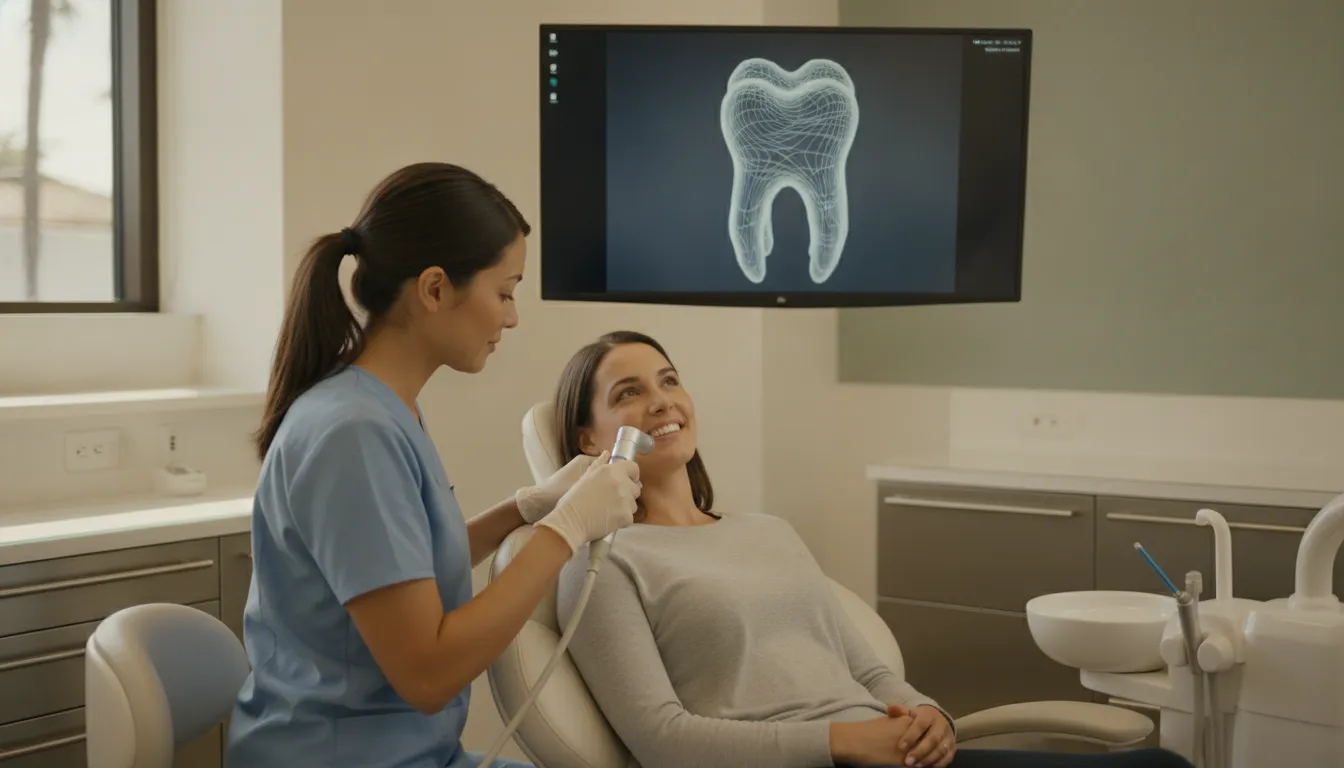
Digital planning also helps connect the surgical plan with the restorative goal. The intended crown, bridge, or denture is considered alongside implant location, bite, and appearance. This restorative-first perspective can make the treatment discussion easier to understand and helps the team coordinate each stage of care.
Clearer planning can also improve the patient experience. When the team can explain what the images show and why a particular approach is recommended, you have a more concrete basis for questions and decisions. It may also help the clinician avoid unnecessary adjustments during treatment, although no technology can eliminate the need for professional evaluation or account for every healing variable.
What technologies should you look for?
- 3D imaging or CBCT: Detailed views of the jaw and nearby structures for individualized planning.
- Digital treatment planning: A way to evaluate implant position in relation to the planned restoration.
- Digital design and milling: Computer-guided workflows for creating accurately fitted restorative components.
- 3D printing: A modern method used in dental laboratories for precise custom restorations.
- Material knowledge: An understanding of how implant materials, including titanium, interact with living bone.
According to the National Institute of Dental and Craniofacial Research, indirect restorations may be custom made using digital design, milling, or 3D printing for precise results: NIDCR dental materials guidance. Titanium has historically been central to osseointegrated implants because of its biocompatibility, although your dentist must assess the complete clinical picture. Ask how imaging, planning, and restoration design work together before choosing an implant provider.
Which Sedation Options Help Anxious Patients Through Implant Care?
Dental implant care can feel intimidating, especially if you have postponed treatment because of dental anxiety or a difficult past experience. Sedation dentistry can help many anxious patients manage implant treatment more comfortably while the dental team completes the planned care. The right approach depends on your health history, the procedure, your anxiety level, and how you prefer to experience treatment.
Oral conscious sedation is one comfort-oriented option. Taken as prescribed before an appointment, it can help you feel relaxed and drowsy while remaining responsive to the dental team. Other approaches may be appropriate in different situations. The important point is that sedation should be individualized rather than treated as a one-size-fits-all solution. The National Institute of Dental and Craniofacial Research recognizes sedation options as part of making the dental implant process more comfortable for patients with anxiety. Learn more from NIDCR.
In short, sedation can support a calmer implant experience, but safe care begins with careful screening, appropriate monitoring, and a trained dental team.
What should you ask about sedation before implant treatment?
- Which sedation option fits my procedure and medical history? Ask how the method works, what you may feel, and how long its effects may last.
- How are patients screened before sedation? The dentist should review medications, allergies, health conditions, prior sedation experiences, and eating or drinking instructions.
- Who monitors me during treatment? Confirm that trained staff monitor your vital signs and remain attentive throughout the appointment.
- What will I need after the visit? Depending on the medication, you may need a responsible adult to drive you home and stay with you while you recover.
At Marcos Ortega DDS, Dr. Ortega brings DOCS-certified sedation expertise to a comfort-first practice in Hillcrest and Downtown San Diego. The goal is not to promise a particular experience, but to create a thoughtful plan that respects your concerns and supports safe, individualized care. Because implant treatment includes both surgical and restorative decisions, discussing sedation with the same team can make the process easier to understand.
If you are comparing providers, review our guide to choosing a qualified sedation dentist. During a consultation, bring your questions and share any fear openly. That information helps the dentist determine whether sedation is suitable and what safeguards your appointment requires.
What the Full Implant Restoration Process Looks Like
Dental implant treatment is a staged process that begins with careful planning. Allows time for the implant to integrate with the jawbone, and ends with a custom restoration designed for your needs.
At Marcos Ortega DDS, surgical and restorative care is coordinated under one roof. That continuity helps your care team evaluate the health of your teeth, gums, and supporting bone before recommending the right path forward. A thorough examination is important because candidacy depends on factors such as bone health, gum condition, and overall health, not simply on the location of a missing tooth. A dental implant consultation gives you an opportunity to discuss your goals, review findings, and understand the proposed sequence before treatment begins.
- Consultation and comprehensive evaluation. Your dentist reviews your medical and dental history, examines the gums and remaining teeth, and assesses the available bone. Imaging and other diagnostic information help determine whether an implant is appropriate and whether additional preparation may be needed. Implant success depends in part on bone quality and quantity, as well as general health, so this evaluation is not a formality. It is the foundation for an individualized plan.
- Implant placement. When the site is ready, the implant is placed in the jawbone. The implant is typically a titanium post. Titanium has long been used for osseointegrated implants because of its biocompatibility. The post serves as a stable foundation for the replacement tooth, while your dentist provides instructions for caring for the area during the early healing period.
- Osseointegration and healing. The jawbone needs time to heal and fuse with the implant post. This process, called osseointegration, is the direct structural and functional connection between living bone and the implant surface. The full process typically spans several months, although the timing varies with the treatment plan and individual healing. Read about the recovery process and timeline so you know what questions to bring to your visit.

Healing is monitored rather than rushed. Follow-up visits allow the team to check the tissues and confirm that the implant is progressing appropriately before the final tooth is attached. If bone quality, gum health, or overall health requires additional attention, the plan can be adjusted to protect the long-term health of the treatment area.
Restoration with a custom replacement tooth. Once the implant has integrated sufficiently, it can support a custom crown, fixed bridge, or removable denture, depending on how many teeth are missing and your functional goals. Modern digital design, milling, and 3D printing can support the fabrication of precise restorations. Explore the options available through restorative dentistry. With surgical planning and restoration coordinated in-house, Marcos Ortega DDS can guide the process from the first evaluation through the final fit and ongoing care.
Questions to Ask Before You Choose a Dental Implants Dentist
The right provider should be able to explain your candidacy, treatment options, technology, comfort plan, and long-term maintenance in clear, understandable language.
A consultation is not only an opportunity to ask about price. It is your chance to understand who will plan your care, who will place the implant. How the replacement tooth will be designed, and what support you can expect afterward. Use the questions below to compare providers and identify an approach that fits your oral health, goals, and comfort level.
- What training and certifications do you have in implant dentistry? Ask about advanced education, continuing training, and experience with cases similar to yours. The American Dental Association’s Journal of the American Dental Association recommends considering a provider’s specific training, experience, and use of technology when making an informed choice: review the clinical guidance.
- How many implants do you place and restore each year? A provider should answer directly and explain how experience applies to your situation. Ask whether they routinely manage more involved cases, including patients with bone or gum concerns.
- Will the surgical and restorative phases be coordinated in-house? Find out whether the same practice can plan placement and provide the crown, bridge, or denture it supports. Coordinated care may make communication simpler, while the treatment plan should still be individualized.
- What imaging and technology will you use? Ask how the team evaluates bone and surrounding tissues, plans implant position, and designs the final restoration. Digital design, milling, and 3D printing are used for precise indirect restorations, according to the National Institute of Dental and Craniofacial Research.
- What sedation options are available? If dental anxiety has delayed care, discuss whether oral or another form of sedation may be appropriate, how you will be monitored, and what restrictions apply afterward. Sedation suitability depends on your health history and the planned procedure.
- How will you determine whether I am a candidate? A thorough examination should consider bone health, gum condition, medical history, and treatment goals. Ask what evaluation is needed before a recommendation is made, since implants are not suitable for everyone.
- What maintenance will I need after treatment? Discuss home hygiene, professional checkups, how the implant and restoration will be monitored, and whom to contact if something changes. Regular maintenance and daily oral hygiene are essential for the health of tissues around an implant. You can also review the likely dental implant investment as part of your planning.
Clear answers should leave you informed, not pressured. If a provider avoids questions about evaluation, credentials, coordination, or follow-up, consider that a reason to seek another consultation.
Frequently Asked Questions
How do I choose the right dental implant dentist in San Diego?
Look for a provider who can explain their implant training, clinical experience, examination process, technology, and approach to restoration. Ask whether the practice can coordinate both implant placement and the final crown, bridge, or denture, and whether the dentist discusses bone and gum health before recommending treatment. A clear treatment plan should address your goals, alternatives, expected stages, maintenance, and fees without pressure.
Am I a candidate for dental implants?
That depends on an examination of your teeth, gums, jawbone, medical history, and overall oral health. Dental implants are not suitable for everyone immediately, and bone quality, bone volume, and gum condition can affect the plan. A dentist may recommend treating active oral health concerns or evaluating additional procedures before implant placement. The right answer comes from an individualized clinical assessment, not an online checklist.
Can sedation help if I am anxious about implant treatment?
Many anxious patients can discuss sedation options as part of their implant plan. A qualified team should review your health history, medications, anxiety level, and the procedure itself before recommending an option. Sedation is not identical for every patient, so ask how you will be monitored, what instructions apply before and after treatment, and who will answer questions during recovery.
How much do dental implants cost?
There is no single price for every case. Cost can vary with the number of implants, the type of restoration, and the complexity of the procedure. Your consultation should separate the surgical and restorative stages and explain any imaging, bone-related procedures, temporary teeth, follow-up care, and payment options that apply. A written estimate after an examination is more useful than a generic advertised price.
Schedule Your Dental Implant Consultation
Choosing an implant dentist is an important decision, and a personal consultation can help you understand your options, expected steps, and questions to discuss before treatment. Marcos Ortega DDS offers individualized guidance for patients considering dental implants in San Diego, including comfort-focused care and surgical and restorative planning. Schedule a free dental implant consultation to talk through your goals and find a treatment path that fits your needs.